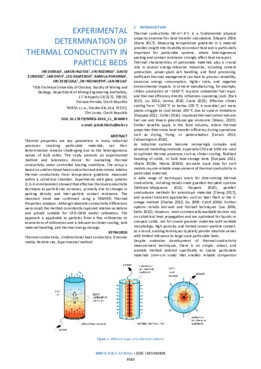
Thermal properties are key parameters in many industrial processes involving particulate materials, yet their determination remains challenging due to the heterogeneous nature of bulk solids. This study presents an experimental method and laboratory device for evaluating thermal conductivity under controlled heating conditions. The setup is based on unidirectional heat conduction and determines relative thermal conductivity from temperature gradients measured within a cylindrical chamber. Experiments with glass spheres (1.5–5 mm diameter) showed that effective thermal conductivity decreases as particle size increases, primarily due to changes in packing density and inter-particle contact resistance. The observed trend was confirmed using a TEMPOS Thermal Properties Analyzer. Although absolute conductivity differences were small, the method consistently captured relative variations and proved suitable for CFD–DEM model calibration. The approach is applicable to particles from a few millimetres to several tens of millimetres and is relevant to clinker cooling, bulk material handling, and thermal energy storage.
 Science Journal